Preventing moisture contamination in semiconductor gas delivery systems
Author
Date Published
Reading Time
Moisture contamination in Semiconductor Gas Delivery Systems can compromise gas purity, affect process stability, and increase the risk of defects. For quality control and safety personnel, prevention requires more than specifying high-purity gas: it also depends on system design, component selection, installation practices, leak testing, and ongoing monitoring. Effective controls must protect gas quality while remaining compatible with the hazards and operating conditions of each fab.
The difficult part is that moisture does not always arrive as an obvious leak. It can enter when a connection is opened, remain on internal surfaces after installation, or be introduced through a sampling arrangement. A cylinder certificate may describe the gas at the supplier’s release point, but it cannot establish what reaches a process tool after the gas has passed through regulators, valves, distribution lines, and maintenance work.
Where moisture enters—and why it stays
A useful investigation follows the gas path from source to point of use, including branches that are normally idle. Cylinder and container changes, regulator replacements, valve maintenance, new tool connections, and analyzer servicing can all expose internal surfaces to ambient air. Even when a line is closed again without a measurable external leak, water adsorbed on those surfaces can desorb gradually into the gas stream.
Leakage is a separate concern. Pressure changes, inadequate seals, damaged fittings, permeation through unsuitable materials, or installation defects can create routes for contamination. The actual direction and significance of transport depend on pressure, gas composition, and the component involved. A pressurized line should not automatically be assumed immune to atmospheric contamination under every operating condition.
Dead legs and rarely used branches deserve attention because exchange with the main flow may be slow. Moisture retained in such locations can appear later, when a valve position changes or a tool begins drawing gas. This is one reason a satisfactory reading taken immediately after a purge is not always enough to demonstrate stable performance.
The process consequences depend on the gas and application. Water can alter surface chemistry, contribute to unwanted reactions, or affect the reproducibility of deposition and etch steps. With some reactive gases, it can also contribute to corrosive byproducts or particle formation. A moisture event should therefore be assessed for both product impact and equipment or personnel hazards, rather than treated only as an impurity-number problem.
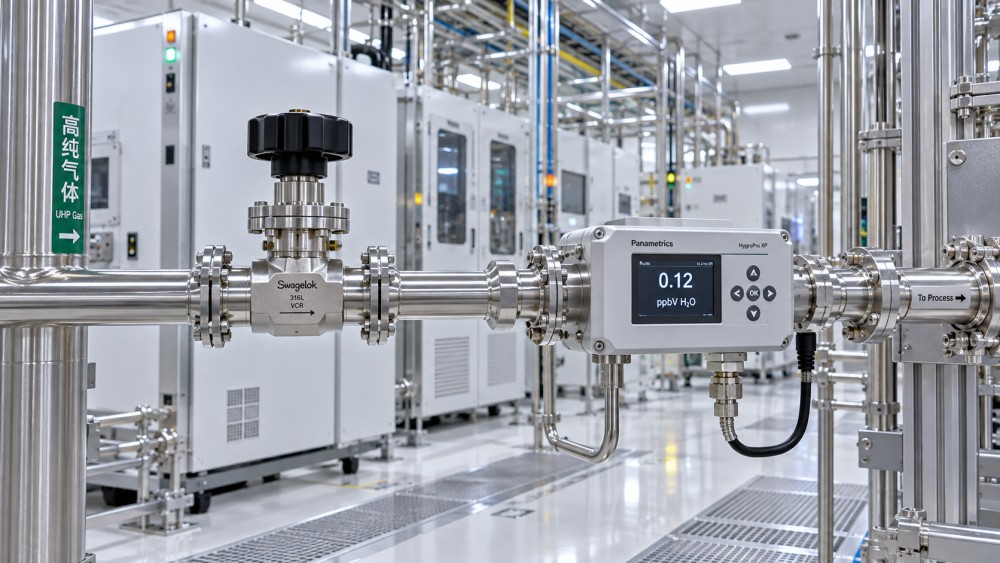
Design the gas path for recovery, not just initial purity
Good design limits unnecessary exposure and makes a system practical to restore after intervention. For many high-purity gas applications, this means selecting compatible, appropriately finished internal surfaces, minimizing unnecessary connections and dead volumes, and providing isolation points that allow a section to be serviced without opening the entire distribution network.
Electropolished stainless steel tubing and welded connections are commonly considered for suitable high-purity applications, but material choice must follow the specific gas chemistry, pressure, temperature, and facility design. Flexible hoses, valve seats, seals, and instrument components need the same scrutiny as tubing: a system is only as appropriate as the materials exposed along its complete gas path.
Maintainability matters as much as the drawing. Ask whether a regulator can be replaced without exposing downstream piping, where a purge can safely enter and exit, and how a sample will be taken without creating a contamination source. Purge and exhaust arrangements must be reviewed for the specific gas hazards; routing a hazardous gas to an unapproved outlet is not an acceptable purity-control shortcut.
Point-of-use purification can provide an additional barrier where compatible and justified. It does not remove the need for clean installation or leak-tight connections downstream. Its suitability depends on the gas, expected contaminants, flow conditions, purifier capacity, monitoring approach, and replacement procedure. A purifier that is poorly located or exhausted may provide less protection than its nominal specification suggests.
Installation and restart are high-risk transitions
A clean component can lose its advantage before the system is commissioned. Packaging integrity, capped ends, controlled storage, clean handling, and limits on exposure time should be part of the installation plan. Welding and assembly procedures should address cleanliness as well as mechanical integrity, with inspection records tied to the installed line.
After assembly or maintenance, a qualified procedure typically combines an appropriate leak test with a controlled purge and moisture verification. These checks answer different questions. A leak test looks for leakage within the sensitivity and conditions of the selected method; it does not prove that internal surfaces are dry. A low moisture reading indicates conditions at the sampling point at that time; it does not, by itself, prove the absence of leaks elsewhere.
Purge gas quality and compatibility are critical. The procedure should define the gas, flow or pressure conditions, sequence, discharge route, and completion criteria for the affected section. Purging is not simply a matter of running gas for a fixed period: internal geometry, surface exposure, and downstream components influence recovery. For hazardous or reactive gases, isolation, exhaust treatment, detection, and other safeguards must follow the site’s approved procedures and applicable requirements.
Restart criteria should also cover the tool interface. A line can meet its facility-side acceptance limit while a newly installed tool connection remains contaminated. Define who owns each boundary, which valves are included in the test, and whether the measured condition represents actual operating flow rather than an isolated test configuration.
Measure the condition that the process actually sees
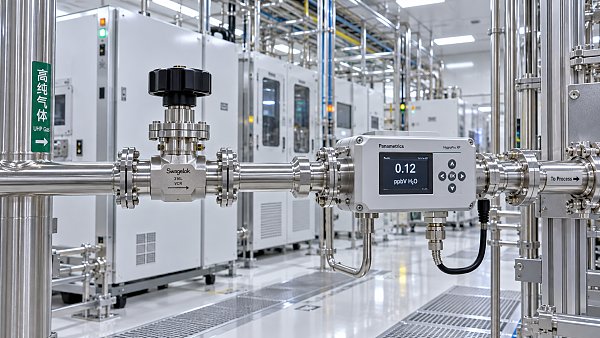
Moisture monitoring is most useful when the measurement location and operating conditions are explicit. A reading near the bulk source can help identify incoming gas problems, while a point-of-use measurement can reveal contamination introduced downstream. For a long distribution network, the two locations answer different questions; neither should be presented as a complete picture of the other.
Specify the measurement unit and basis, the gas matrix, pressure, flow, detection capability, uncertainty, and response time. Moisture may be expressed as a concentration or as a dew point, but those values cannot be compared casually without considering the stated basis and conditions. Set acceptance and alarm limits from process requirements and verified instrument capability, not from a generic number copied from another line.
The sample system can be the weak link. Long sample lines, unsuitable materials, unused branches, or exposed fittings can retain or release water and delay a representative reading. An analyzer may indicate a transient created by its own sampling path rather than the process line. Calibration, maintenance, and safe sampling provisions should therefore be included in the monitoring plan from the beginning.
Trending is more informative than a single pass or fail. Compare readings with operating state, cylinder changes, tool demand, maintenance, and recovery after idle periods. A rising baseline after repeated interventions may point to a procedural or component issue even if no individual reading has yet crossed the action limit.
When a moisture alarm occurs
Do not assume the analyzer is wrong, but do not assume the source gas is responsible either. Follow the site’s alarm and safety procedures, assess whether the affected gas presents an immediate hazard, and place potentially affected material or equipment under the appropriate quality hold. Decisions to isolate, purge, or shut down must be made by authorized personnel using the approved gas-specific procedure.
The investigation should preserve a timeline: the first abnormal reading, flow and pressure conditions, recent maintenance, source changes, valve positions, analyzer status, and affected tools. Check whether the measurement is credible, including instrument diagnostics and sample-path condition, without bypassing safety controls to obtain another reading.
Then narrow the boundary. If an upstream reading is normal but a downstream reading is elevated, the affected section may lie between them, although sampling limitations must be considered. A spike following a connection change suggests an exposure-related mechanism; a recurring increase after idle periods may warrant examination of stagnant volumes or surface desorption. These are investigation hypotheses, not proof of root cause.
Release should require documented evidence that the cause has been addressed, the relevant line is within its approved limits under representative conditions, and the quality impact has been assessed. For sensitive processes, that assessment may include tool checks or additional process qualification defined by the fab.
What to settle with suppliers before installation
A component specification alone does not establish a qualified delivery system. Purchasing and engineering teams should agree on gas compatibility, cleaning and packaging, permissible exposure during installation, inspection records, leak-test methods, and moisture acceptance points. The contract should also make clear who supplies purge gas, analyzers, temporary connections, and safe exhaust provisions during commissioning.
Service support is particularly relevant for localized supply. A nearby supplier may shorten a delivery route, but proximity does not demonstrate consistent cleanliness, traceability, spare-parts availability, or the ability to support the fab’s qualification process. Ask for evidence appropriate to the application, and distinguish a component-level test from sustained performance in the installed system.
That distinction reflects the approach planned for FabBrief, a bilingual semiconductor manufacturing information portal: evaluate technical claims alongside qualification, supply continuity, and operating conditions. For an existing gas line, the next practical step is to map its exposure points, sampling locations, and ownership boundaries, then compare them with maintenance history and process-specific limits. The gaps revealed by that review are often more actionable than another general purity specification.
Questions about market trends? Contact Market Scope Live for deeper business insights.
We respect your privacy. Your information is strictly confidential.
We respect your privacy. Your information is strictly confidential.
Related News
 Wafer Fab EquipmentHow to size semiconductor manufacturing equipment for wafer fabsSize semiconductor manufacturing equipment for wafer fabs with confidence. Learn to model capacity, assess bottlenecks, and make smarter procurement decisions.MORE+
 Wafer Fab EquipmentWhen should semiconductor manufacturing equipment maintenance be scheduled?Semiconductor manufacturing equipment maintenance should follow approved time, usage, and condition limits. Learn how to schedule service and protect production.MORE+
 Wafer Fab EquipmentWhen should chemical vapor deposition equipment be cleaned?Chemical Vapor Deposition Equipment cleaning depends on buildup, defect trends and validated limits. Learn when to act to protect wafer quality and uptime.MORE+
 Wafer Fab EquipmentHow residual gas analyzers help detect vacuum chamber leaksResidual Gas Analyzers help detect vacuum chamber leaks. Explore gas signatures, tracer testing, and practical steps to pinpoint problems with confidence.MORE+
 Wafer Fab EquipmentHow to Test Material Handling Recovery After a Power OutageHow can I test material handling recovery after a power outage? Explore a practical guide to verifying carrier locations, safe transfers, and system readiness.MORE+
 Wafer Fab EquipmentWhat to Do When a Wafer Handling Robot Drops a WaferWhat should I do if a wafer handling robot drops a wafer? Learn how to contain risks, protect affected lots, investigate the cause, and safely restart production.MORE+
 Wafer Fab EquipmentDoes a PVD Tool Need a Dedicated Cooling Water Supply?Does a PVD tool need a dedicated cooling water supply? Discover when shared cooling works, when a chiller is needed, and what to check before installation.MORE+
 Wafer Fab EquipmentRapid thermal processing or batch furnaces for wafer annealing?Semiconductor Thermal Processing Equipment: Compare RTP and batch furnaces for wafer annealing to find the right fit for your process, throughput and yield goals.MORE+
 Wafer Fab EquipmentPreventing moisture contamination in semiconductor gas delivery systemsSemiconductor Gas Delivery Systems need effective moisture control. Discover practical design, monitoring, and maintenance strategies to protect gas purity.MORE+