When should semiconductor manufacturing equipment maintenance be scheduled?
Author
Date Published
Reading Time
Schedule semiconductor manufacturing equipment maintenance at the earliest applicable limit set by the approved maintenance plan: elapsed time, accumulated use, component condition, or a process-performance threshold. Reserve the production window before that limit is reached, allowing time for safe shutdown, service, recovery, and verification. A deteriorating condition or a safety interlock may require an earlier intervention, even when the next preventive maintenance date is weeks away.
The right interval is specific to the tool, chamber, process recipe, materials, and duty cycle. A calendar date is useful for coordination, but it cannot show whether a chamber has accumulated an unusually heavy deposition load or whether a pump has spent most of the period idle. Scheduling works best when each maintenance task has a defined trigger and a clear return-to-service requirement.
Start with the task, then select its trigger
Equipment suppliers commonly specify initial maintenance intervals and procedures for a particular configuration. Use the applicable tool documentation and site-approved maintenance plan as the starting point. Record whether each interval is measured in calendar time, operating hours, wafer count, process cycles, or another counter. The counter must match the wear mechanism closely enough to support a scheduling decision.
A component with a shelf-life or elapsed-time limit may need attention even on a lightly used tool. A chamber exposed to process byproducts, by contrast, can reach its cleaning threshold sooner under a demanding recipe than under a lighter product mix. A wafer count alone hides differences in film thickness, gas chemistry, and recipe duration.
For a multi-chamber system, keep chamber-level histories where the maintenance plan supports them. A tool-level total can conceal the fact that one chamber processed more wafers or ran a more aggressive recipe. Shared equipment, such as a common exhaust or vacuum subsystem, may need a separate trigger based on its own operating hours and service history.
Where several limits apply to the same task, use the first approved trigger reached. Do not extend a supplier-defined interval solely because a sensor reading looks normal; a monitored signal may not detect every degradation mode. Any interval change should follow the site's documented engineering approval and validation process.
Use condition signals to move the window forward
Condition monitoring is most useful when a signal is compared with a meaningful baseline and the associated operating conditions are known. A rising pump-down time, for example, can indicate a leak, pump degradation, a restriction, or a change in the pump-down sequence. It is a reason to investigate and potentially advance service, not proof that one particular part has failed.
Useful scheduling signals vary by equipment and process. Examples include:
- Vacuum behavior: pump-down time, base pressure, or pressure stability under a comparable recipe and chamber state.
- Process control: repeated excursions or drift in temperature, pressure, gas-flow control, or plasma-related parameters.
- Particle and defect results: an increase relative to an established monitor baseline, with the wafer type and inspection method held comparable.
- Mechanical condition: abnormal vibration, motion faults, or changes in positioning repeatability where those measurements are available and validated.
- Service history: recurrence of the same fault after a previous repair, particularly if the replacement addressed a symptom without identifying its source.
A single alarm does not always establish a trend. Compare readings taken under equivalent conditions, including recipe, chamber temperature, idle time, and recent service history. A particle excursion immediately after a chamber clean, for instance, calls for a different investigation from a gradual increase during a long production run. Confirm the measurement before changing a schedule, but do not wait for a trend to mature when an approved alarm response requires immediate action.
Set response levels in the maintenance plan: when to observe more closely, when to arrange a service slot, and when to stop using the affected equipment. Those levels should come from validated site limits, supplier guidance, and process engineering decisions, rather than a generic threshold applied across tools.
Choose a window that includes recovery
The maintenance window starts before a technician opens the tool and ends only after the required release activities are complete. Its duration can include lot clearance, isolation, venting or cooldown, the physical work, reassembly, leak checks, pump-down, warm-up, calibration, conditioning, and process verification. The sequence and time required vary with the equipment and the work performed.
A short opening between production lots may be suitable for an external inspection but insufficient for a chamber intervention that requires venting and subsequent conditioning. Scheduling only the hands-on repair time creates pressure to shorten recovery or to return the chamber before the agreed evidence is available.
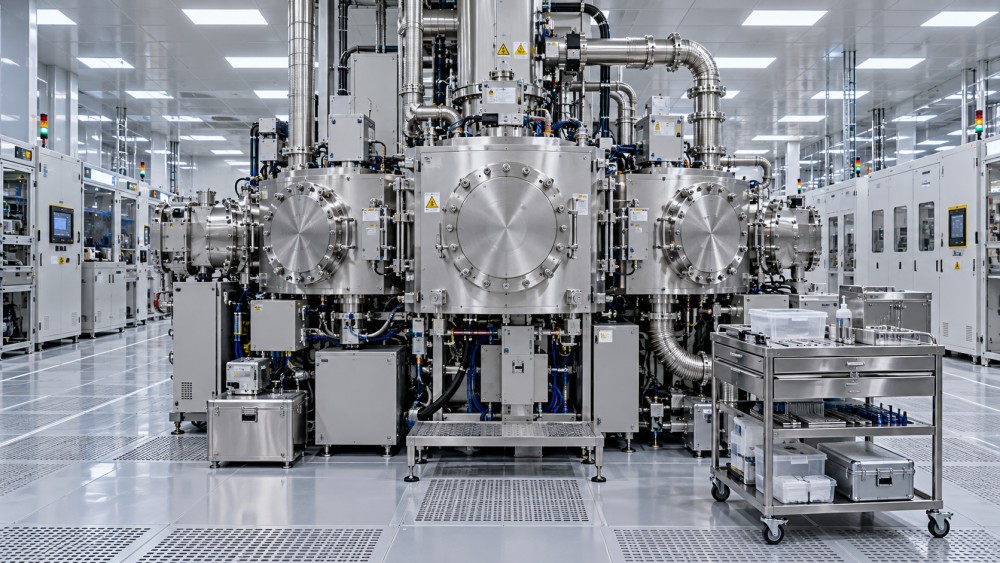
Coordinate the intervention with the dispatch plan and the tool's redundancy. A multi-chamber tool may permit work on one chamber while others remain available, but only if the equipment configuration, isolation procedure, and site rules explicitly allow it. Shared utilities, common vacuum paths, software changes, and safety interlocks can make an apparently local task a tool-wide interruption.
Batching compatible tasks into one outage can avoid repeated venting or access work. It can also complicate troubleshooting: if several components and settings change together, a subsequent process shift is harder to trace. Group tasks when their procedures and verification requirements are compatible, and record each change separately. Preserve a clear sequence of events when investigating an intermittent fault.
Plan around material and access constraints
A reserved slot is not ready merely because the production calendar is clear. Confirm that the correct part revision, approved consumables, special tools, procedures, and trained support are available. Account for cleanroom entry, contamination-control requirements, equipment isolation, and any permits or site authorizations required for the task.
Some replacement components require clean packaging, controlled storage, or preparation before installation. A substitute that fits mechanically may still be unsuitable for the process or tool configuration. If the correct part is unavailable, reassess the maintenance window and operating risk through the site's escalation process; do not assume a delayed service is acceptable simply because the tool continues to run.
Distinguish planned service from an urgent response
Preventive maintenance is scheduled before a known limit or expected deterioration. Corrective maintenance follows an identified fault. Condition-based work sits between them: evidence indicates that intervention should occur before the next planned date, but the appropriate response still depends on the validated alarm limits and the consequences of continued operation.
A safety interlock, hazardous leak indication, or other condition covered by an immediate-stop procedure takes priority over production scheduling. Place the equipment in the required safe state and follow site isolation and escalation procedures. Do not bypass an interlock or treat a production window as authorization to defer an immediate response.
For a noncritical condition, the decision can be more nuanced. An intermittent motion fault that has stopped lots repeatedly may justify an earlier slot even if the component has not reached its scheduled replacement count. Conversely, an isolated monitor result that cannot be reproduced may first require measurement review and diagnostic work. Document the reason for either decision, the operating restrictions, and the next review point.
Set the release criteria before service begins
Maintenance completion and production release are separate events. Agree in advance on the evidence required for the specific intervention, who reviews it, and what happens if the result falls outside the approved range. The release plan should reflect both the equipment function touched and its potential effect on the process.
After a vacuum component replacement, the plan might include a specified leak check and pump-down assessment. After work inside a process chamber, it may also require conditioning, particle monitoring, calibration, or qualification wafers under the site's approved procedure. A successful mechanical test alone does not establish that the process is ready for product.
Record the as-found condition, work performed, replaced part identifiers, counter readings, relevant software or setting changes, and verification results. Reset or update maintenance counters only according to the site's rules, and retain the pre-service reading so that component life can be evaluated later. If verification fails, keep the affected equipment in its designated hold state and investigate before rescheduling production.
Adjust intervals using comparable evidence
After several maintenance cycles, review whether the original trigger predicts the condition found during service. A component repeatedly removed in acceptable condition may be a candidate for interval review; a chamber that accumulates deposits faster after a recipe change may need a shorter interval. Neither observation alone proves the correct new limit.
Compare like with like: chamber configuration, recipe mix, production volume, service scope, and the method used to assess wear. Include failures and unplanned interventions, not only successful scheduled work. A tool that appears to need little maintenance may simply have operated fewer hours or processed less demanding recipes than its peers.
When an interval is proposed for change, define the evidence to be collected, the approval path, and the conditions that would end the trial. Keep existing safety requirements and binding site controls in force. Review the resulting process and equipment data before adopting the change as routine.
Revisit the schedule whenever the operating assumptions change substantially, such as after a new recipe, chamber hardware modification, extended idle period, or change in shared utility conditions. The next maintenance date should follow the current exposure and approved limits, not an old calendar entry carried forward without review.
Questions about market trends? Contact Market Scope Live for deeper business insights.
We respect your privacy. Your information is strictly confidential.
We respect your privacy. Your information is strictly confidential.
Related News
 Wafer Fab EquipmentHow to size semiconductor manufacturing equipment for wafer fabsSize semiconductor manufacturing equipment for wafer fabs with confidence. Learn to model capacity, assess bottlenecks, and make smarter procurement decisions.MORE+
 Wafer Fab EquipmentWhen should semiconductor manufacturing equipment maintenance be scheduled?Semiconductor manufacturing equipment maintenance should follow approved time, usage, and condition limits. Learn how to schedule service and protect production.MORE+
 Wafer Fab EquipmentWhen should chemical vapor deposition equipment be cleaned?Chemical Vapor Deposition Equipment cleaning depends on buildup, defect trends and validated limits. Learn when to act to protect wafer quality and uptime.MORE+
 Wafer Fab EquipmentHow residual gas analyzers help detect vacuum chamber leaksResidual Gas Analyzers help detect vacuum chamber leaks. Explore gas signatures, tracer testing, and practical steps to pinpoint problems with confidence.MORE+
 Wafer Fab EquipmentHow to Test Material Handling Recovery After a Power OutageHow can I test material handling recovery after a power outage? Explore a practical guide to verifying carrier locations, safe transfers, and system readiness.MORE+
 Wafer Fab EquipmentWhat to Do When a Wafer Handling Robot Drops a WaferWhat should I do if a wafer handling robot drops a wafer? Learn how to contain risks, protect affected lots, investigate the cause, and safely restart production.MORE+
 Wafer Fab EquipmentDoes a PVD Tool Need a Dedicated Cooling Water Supply?Does a PVD tool need a dedicated cooling water supply? Discover when shared cooling works, when a chiller is needed, and what to check before installation.MORE+
 Wafer Fab EquipmentRapid thermal processing or batch furnaces for wafer annealing?Semiconductor Thermal Processing Equipment: Compare RTP and batch furnaces for wafer annealing to find the right fit for your process, throughput and yield goals.MORE+
 Wafer Fab EquipmentPreventing moisture contamination in semiconductor gas delivery systemsSemiconductor Gas Delivery Systems need effective moisture control. Discover practical design, monitoring, and maintenance strategies to protect gas purity.MORE+