Choosing semiconductor encapsulation materials for high-humidity environments
Author
Date Published
Reading Time
Choosing semiconductor encapsulation materials for high-humidity environments requires more than comparing moisture absorption figures. Engineers must also assess adhesion, thermal performance, ionic contamination, and compatibility with package design and manufacturing processes. The useful question is not simply which material absorbs less water, but whether the complete package can maintain electrical and mechanical integrity under the conditions it will actually encounter.
That distinction matters because humidity-related failures rarely originate in the encapsulant alone. Moisture can enter through the bulk material, travel along an interface, or accumulate around defects. Its effect depends on the conductors, surface residues, electrical bias, temperature and mechanical stresses present inside the package.
Start with the exposure and the package, not the datasheet
“High humidity” covers several different operating conditions. A device stored in a humid warehouse, a sensor exposed to outdoor temperature swings, and a powered module inside an industrial enclosure do not face identical risks. Before comparing formulations, establish whether the concern is sustained humidity, condensation, intermittent wetting, elevated temperature, electrical bias, or a combination of these factors.
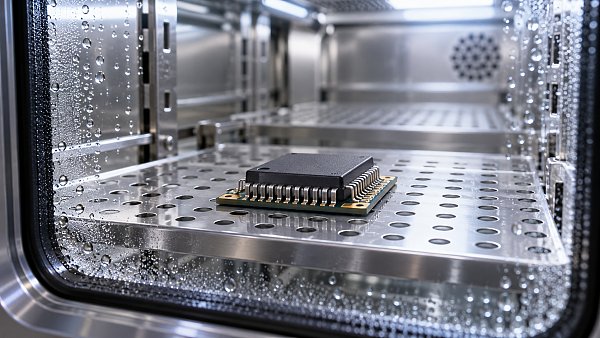
Define the expected service life and the periods during which the device is powered. Condensation deserves separate attention: relative humidity can rise locally when a surface cools, even if the surrounding environment does not appear exceptionally humid. Liquid water, contaminants and voltage can create failure conditions that a simple moisture-uptake measurement will not capture.
The package geometry is equally important. Encapsulant thickness, exposed edges, lead exits, bond-wire layout, substrate finish and interfaces with other polymers all affect the route moisture can take. A material qualified in a thick, well-supported package should not automatically be assumed suitable for a thin package with long interfaces or sensitive fine-pitch structures.
Consider the intended role of the encapsulant as well. A molded compound, a dispensed glob-top and a potting material may all protect semiconductor assemblies, but they are applied differently and face different constraints. If the device requires an exposed sensing surface or an optical path, full coverage may not even be an option.
Where moisture causes damage
Most polymer encapsulants are not hermetic barriers. Water can diffuse through them over time, and the relevant exposure depends on both the material and the distance to vulnerable features. A low absorption value is useful for screening, but it does not by itself describe the rate of moisture transport, the strength of an interface after aging, or the chemical environment around a metal trace.
Interfaces often deserve as much attention as the bulk material. Moisture-assisted delamination between an encapsulant and a die, leadframe or substrate can create pathways toward sensitive areas. Temperature cycling may add mechanical strain, while absorbed moisture can contribute to internal stresses during rapid heating. Corrosion and electrochemical migration become particular concerns when moisture, mobile ions and electrical bias are present together.
This is why the apparent winner in a material-only test may not be the winner in a finished package. A formulation with attractive bulk properties can still fail if it does not wet or adhere consistently to the actual production surface.
Compare material families by their trade-offs
Epoxy-based molding compounds are widely used in semiconductor packaging because they can be formulated for production molding, mechanical protection and adhesion. Filled formulations can also help control thermal expansion. Their performance, however, depends heavily on resin chemistry, filler, cure and the surfaces being bonded. A compound intended for one package or molding process is not automatically interchangeable with another.
Silicone encapsulants are often considered when flexibility or reduced mechanical stress is important. That compliance can help protect delicate structures, but silicones generally permit greater moisture and gas transport than many epoxy formulations. They therefore require particular scrutiny where the primary requirement is restricting moisture access. Adhesion, cure inhibition and contamination of nearby processes also need to be evaluated for the specific product.
Polyurethane and other potting systems can be useful for certain module-level assemblies, especially where dispensing and stress management matter. They should not be treated as direct substitutes for semiconductor molding compounds without checking ionic cleanliness, thermal endurance, cure behavior and compatibility with the device. Properties vary substantially by formulation.
If the application genuinely requires a hermetic barrier, changing the polymer alone may not solve the problem. A hermetic package or a different protective architecture may be necessary, with its own cost, size and assembly implications. The decision should follow the required leakage and lifetime evidence, not the label “moisture resistant.”
Read critical properties in context
Moisture uptake and transport
When comparing absorption figures, request the test method, specimen thickness, conditioning temperature, relative humidity and exposure duration. Values measured under different conditions are not directly comparable. Ask whether the result represents uptake after a fixed interval or after the specimen has approached equilibrium. For a thin package subjected to repeated humidity cycles, the rate of uptake and drying may be just as relevant as the ultimate absorbed amount.
Permeability or diffusion data can help, but those measurements also have boundaries. They do not account for voids, cracks or poor adhesion created during assembly. Use them to narrow the shortlist, not to predict field lifetime on their own.
Adhesion and mechanical behavior
Ask for adhesion results on the actual materials in the stack: die passivation, substrate solder mask, copper or leadframe finish, and any coating or primer. Surface preparation and storage before encapsulation can change the outcome. Ideally, assess adhesion both before and after humidity and thermal exposure rather than relying only on an initial bond-strength value.
Coefficient of thermal expansion, modulus and glass transition temperature should be considered together. A stiff material may hold its shape well but transfer more stress to a fragile die or interface. A more compliant material may reduce stress but introduce other compromises, including dimensional stability or moisture transport. Review properties across the actual temperature range, including behavior above and below the glass transition where relevant.
Ionic contamination and electrical reliability
Water becomes more damaging when it carries mobile ionic contaminants. Ask suppliers how extractable ionic content is measured and controlled, including the extraction method and limits used for production lots. Chloride and other ionic species can be relevant, but a single reported value does not represent the cleanliness of the entire assembly.
Flux residues, cleaning chemistry, handling and substrate contamination may contribute as well. Electrical testing under humidity and bias is therefore more informative than treating the encapsulant’s purity specification as a complete corrosion assessment.
Thermal performance
A higher stated thermal conductivity can be attractive in a power package, but heat must still pass through the actual geometry and interfaces. Filler loading, voids, bond-line thickness and contact quality can influence the effective heat path. More filler can also change viscosity, flow and stress behavior. Compare thermal performance in the assembled design, not only in a bulk sample.
Qualification should reproduce the failure risk
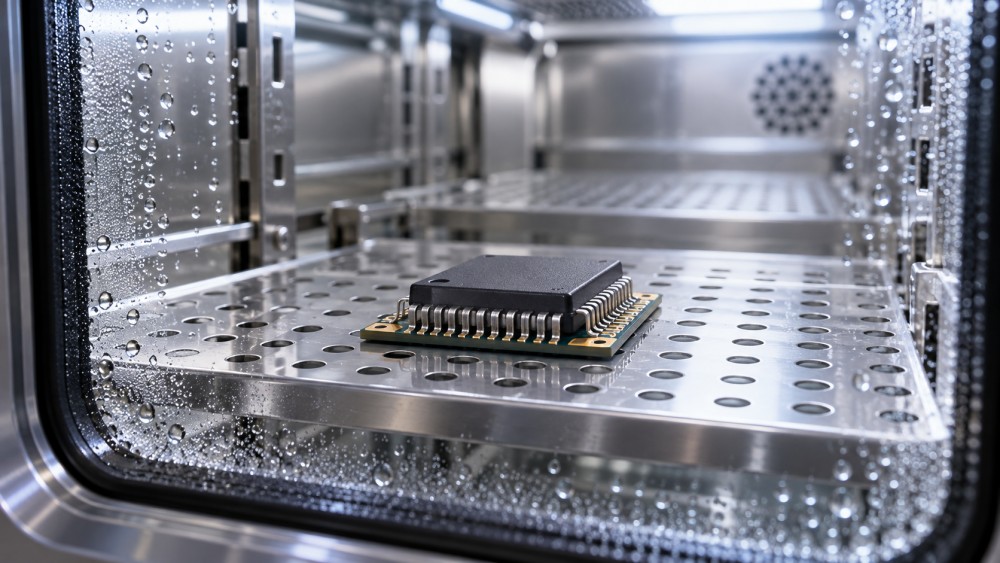
A practical qualification plan combines material screening with tests on representative assembled packages. Start by identifying the likely failure mechanisms, then choose stresses and inspections that can reveal them. Relevant JEDEC methods include JESD22-A101 for steady-state temperature-humidity bias testing, JESD22-A110 for highly accelerated temperature and humidity stress testing, and JESD22-A118 for unbiased highly accelerated stress testing. The applicable revision, conditions and acceptance criteria should be confirmed for the device and customer requirements.
Biased testing can reveal electrical degradation mechanisms that an unbiased exposure may miss. Unbiased testing can still be valuable for examining package integrity and material interactions. Accelerated tests are screening tools: passing one does not automatically establish a field lifetime, and an aggressive condition may activate mechanisms that are not representative of normal service.
For surface-mount packages exposed to solder reflow, moisture sensitivity and preconditioning also matter. The IPC/JEDEC J-STD-020 and J-STD-033 documents address moisture sensitivity classification and handling of moisture-sensitive devices, respectively. Their applicability and current revisions should be checked for the package and assembly route. A moisture sensitivity classification addresses a defined reflow-related risk; it is not a general guarantee of humidity resistance during years of powered operation.
Plan inspections before testing begins. Depending on the design, these may include electrical measurements, visual examination, acoustic microscopy for internal delamination, and destructive cross-sectioning of selected samples. Record the sample size, lots, exposure conditions, readout intervals and failure criteria. A report that says only “passed humidity testing” leaves too much unanswered for a meaningful comparison.
A promising formulation still has to run in production
Process compatibility can eliminate a candidate that otherwise looks strong. For molding, check flow behavior, cure window, mold release, filler distribution and the risk of wire sweep or voids. For dispensing and potting, assess viscosity over the usable working time, air entrapment, coverage around tight features and cure uniformity. A laboratory dispense onto a flat coupon is a limited proxy for a densely populated production assembly.
Storage and handling are part of the specification. Shelf life, temperature controls, mixing requirements, thawing procedures where applicable, and allowable time after opening can affect both yield and reliability. Confirm whether the proposed cure schedule is compatible with nearby components and factory capacity. A longer cure or an additional surface treatment may be acceptable, but its throughput and cost implications should be visible before selection.
Also establish what happens when the supplier changes a raw material, production site or formulation. A material with excellent qualification data is less useful if lot consistency, change notification or requalification support is uncertain. Local availability can reduce some logistics exposure, but local production alone does not prove equivalent purity, capacity or process control.
Make the decision with comparable evidence
For a serious comparison, give shortlisted suppliers the same package description, environmental profile and manufacturing constraints. Request the underlying conditions for moisture, adhesion, thermal and ionic data; representative qualification reports where available; and the proposed storage, application and cure requirements. Identify which results come from laboratory samples, which use a comparable package, and which reflect sustained production.
FabBrief’s planned coverage of process materials and supply chains is built around that distinction: a promising technical result is not the same as a qualified process or dependable volume supply. For the immediate material decision, the next useful step is a joint review of package drawings, exposure assumptions, failure criteria and supplier test methods. If those inputs are unclear, a numerical comparison of datasheets is likely to create confidence before it creates understanding.
Questions about market trends? Contact Market Scope Live for deeper business insights.
We respect your privacy. Your information is strictly confidential.
We respect your privacy. Your information is strictly confidential.
Related News
 Process MaterialsHow does the photomask manufacturing process transfer a pattern?Discover how the photomask manufacturing process turns circuit layouts into precise mask patterns and transfers them to wafers through lithography.MORE+
 Process MaterialsWhy do EUV photomasks use reflective multilayer structures?EUV photomasks use reflective multilayers to overcome absorption at 13.5 nm. Discover how mirror design, imaging and defect control affect performance.MORE+
 Process MaterialsHow are photomasks used in semiconductor lithography?Photomasks for semiconductor lithography shape chip features layer by layer. Explore DUV and EUV masks, defect control, and their impact on manufacturing yield.MORE+
 Process MaterialsHow does sputtering target purity affect thin-film quality?Sputtering Targets can shape thin-film quality and process consistency. Discover how purity, contamination, and qualification affect your results.MORE+
 Process MaterialsHow buried oxide thickness affects silicon-on-insulator wafersSilicon-on-Insulator Wafers depend on buried oxide thickness for isolation, heat dissipation, and device control. Explore the trade-offs and choose the right stack.MORE+
 Process MaterialsWhy Is Ultrapure Water Resistivity Dropping?Why is ultrapure water resistivity dropping? Discover common causes, measurement pitfalls, and practical troubleshooting steps to restore water quality.MORE+
 Process MaterialsHow etch selectivity affects semiconductor fabricationSemiconductor Etchants shape selectivity, mask survival, and device quality. Discover how to balance material protection, profile control, and process efficiency.MORE+
 Process MaterialsChoosing semiconductor encapsulation materials for high-humidity environmentsSemiconductor Encapsulation Materials for high-humidity environments: compare moisture resistance, adhesion, reliability testing and production trade-offs.MORE+