Why do EUV photomasks use reflective multilayer structures?
Author
Date Published
Reading Time
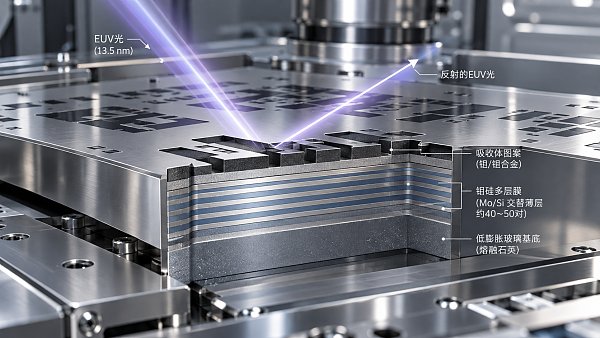
EUV photomasks use reflective multilayers because the 13.5-nanometer light used in extreme ultraviolet lithography is strongly absorbed by materials that would otherwise form a transmissive mask. Instead of sending light through a patterned film, the mask reflects it from a carefully engineered stack of thin layers. An absorber pattern on top determines which parts of that reflected field contribute to the image projected onto the wafer.
The multilayer is therefore central to both the optical performance and the manufacturing difficulty of an EUV mask. It provides useful reflectivity at a wavelength where ordinary interfaces reflect poorly, but its performance depends on layer thickness, interface quality, illumination angle and defect control. For a technical evaluator, the question is not simply whether a mask reflects EUV light; it is whether the complete patterned mask can produce the required image consistently under the conditions of a particular lithography process.
Why transmission is impractical at 13.5 nanometers
In optical lithography at longer wavelengths, a photomask can use a transparent substrate with patterned regions that block light. That approach depends on having a material thick enough to make a practical substrate while still transmitting enough of the exposure wavelength.
At EUV wavelengths, absorption changes the calculation. Light loses intensity rapidly as it passes through solid material, so a conventional substrate would consume too much of the available exposure light. Making the material thinner can reduce absorption, but a film thin enough to transmit useful EUV light would present substantial challenges in mechanical support, flatness and defect control. A reflective mask avoids the need to transmit the exposure beam through a conventional mask substrate.
Reflection is not effortless, however. A single material interface at the relevant incidence angles does not provide the high reflectivity needed for an efficient lithography system. EUV optics therefore use multilayer mirrors: many thin interfaces work together to reinforce the reflected wave. The mask uses the same physical principle, with the added requirement that its surface carry a precise circuit pattern.
How the multilayer creates a usable reflection
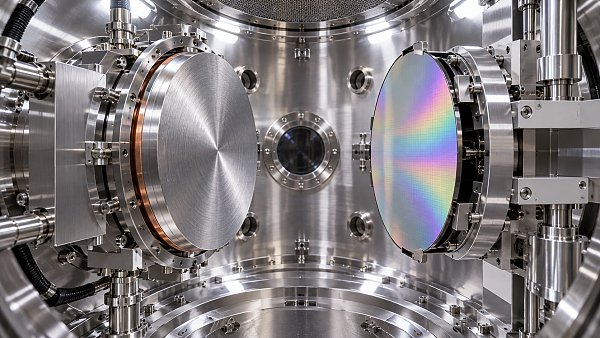
A common EUV mask blank consists of alternating molybdenum and silicon layers deposited on a low-expansion substrate. Each interface reflects a small portion of the incoming light. When the layer spacing is chosen appropriately, contributions from successive interfaces return in step and reinforce one another through constructive interference. This is often described as Bragg reflection.
The reflected wave is the combined result of the entire stack, not just its top surface. Layer thickness and interface quality determine how effectively those contributions reinforce one another. Roughness, intermixing between materials and thickness errors can reduce reflectivity or alter the phase of the reflected light. Adding more layer pairs does not provide unlimited improvement: absorption within the stack and imperfections eventually limit the benefit.
Above the multilayer, a protective capping layer helps preserve the reflective surface during mask processing and use. The patterned absorber sits above that. Regions covered by the absorber return much less useful EUV light than uncovered regions, creating the contrast from which the projection optics form a wafer image. The absorber is not an ideal black material, however; its thickness, material and geometry also influence the reflected optical field.
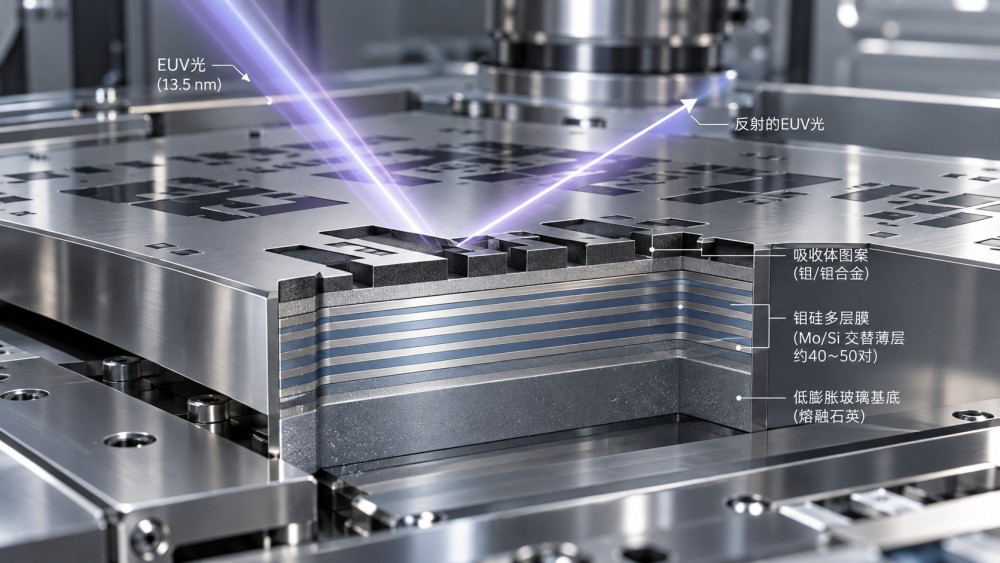
The stack is designed for a narrow range of wavelengths and angles. A reflectivity figure is meaningful only with its measurement conditions: wavelength, angle of incidence, polarization and whether the measurement was taken on an unpatterned blank or on a patterned mask all matter. A favorable blank measurement alone does not establish the image quality of a completed mask.
Why reflection changes the printed image
A reflective mask must be illuminated and viewed at different angles so that the incident and reflected beams can be separated. Consequently, EUV illumination reaches the mask at an oblique angle rather than straight on. The finite height and three-dimensional shape of the absorber then affect how light interacts with the pattern.
One consequence is mask shadowing. Depending on the orientation and geometry of a feature, the absorber can cause an apparent displacement or change in the aerial image. Features with different orientations may therefore print differently even when their intended dimensions are the same. The effect depends on the illumination, mask design and projection system; it cannot be assessed from absorber thickness alone.
The multilayer also contributes phase as well as amplitude to the reflected field. Light reflected from covered and uncovered areas can differ in phase, and that difference interacts with diffraction from the pattern. At small feature dimensions, treating the mask as a flat, two-dimensional arrangement of perfectly bright and dark areas can miss effects that matter to the final image.
For evaluation, this makes the connection between mask specification and wafer result especially important. A mask can meet a dimensional target in inspection yet still require optical modeling and process verification to establish how its three-dimensional structure affects critical dimensions, placement and process window. Mask corrections can compensate for some systematic effects, but their effectiveness depends on the pattern and the lithography conditions for which they are developed.
Defects can originate inside the mirror stack
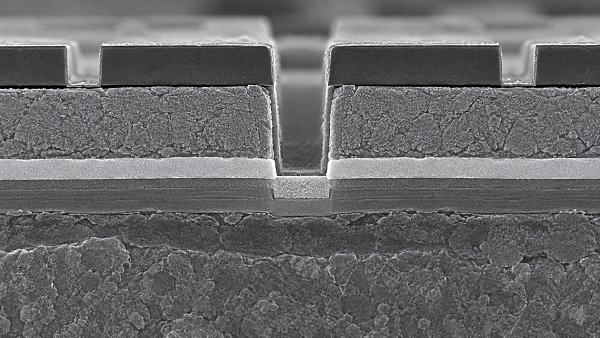
The multilayer improves reflection, but it also creates a defect-control problem distinct from that of a simple patterned surface. A particle or imperfection on the substrate can distort layers deposited over it. A defect introduced during deposition can likewise disturb the local structure of the stack. Such buried defects may change the amplitude or phase of reflected light even when the surface does not show an obvious absorber-pattern error.
Whether a defect matters depends on more than its physical size. Its position relative to the patterned features, its optical effect and the imaging conditions all influence whether it can print on the wafer. A defect detected on a blank is therefore not automatically a yield-limiting defect on every finished mask. Equally, a visually subtle multilayer disturbance should not be dismissed solely because it is small.
Detection, printability assessment and disposition are separate steps. Inspection methods can reveal different classes of defects, but interpreting their importance requires an understanding of how the mask is used. Inspection at the EUV exposure wavelength is valuable because it probes the relevant optical response, although inspection capability and throughput must be considered for the particular application. Other inspection and metrology methods remain useful, with different sensitivities and coverage.
Repair also depends on defect location. An absorber-pattern defect may be accessible to a repair process, while a defect buried in the multilayer cannot simply be removed from the surface without potentially disturbing the reflective stack. Preventing blank defects, characterizing them early and considering their locations during mask planning can therefore be as important as correcting pattern defects later.
What to ask when comparing mask performance
The reflective design links several specifications that are easy to examine in isolation. Higher measured reflectivity is useful for the exposure budget, but it does not by itself establish adequate contrast, defect performance or imaging accuracy. Conversely, a mask optimized for one optical condition or pattern class should not be assumed to perform identically in another.
A technical review should establish the conditions behind the reported results and connect them to the intended process:
- Reflectivity and uniformity: What wavelength, incidence angle and measurement area were used? Are the results for the blank, the finished mask or both?
- Patterned-mask imaging: How do absorber geometry and multilayer phase affect the relevant feature orientations, critical dimensions and placement targets?
- Defect sensitivity: Which blank and patterned-mask defect types can be detected, and how is their likelihood of printing assessed for the intended layers?
- Process compatibility: How are cleaning, handling, inspection and repair controlled so that they do not degrade the cap, absorber or multilayer?
- Production evidence: Are the reported results from an isolated demonstration, a qualified process for a defined application or sustained production under stated conditions?
These questions also clarify cost. A reflective blank requires precision deposition and characterization before patterning begins, while the finished mask adds demanding inspection and defect-disposition work. The resulting cost and turnaround depend on mask complexity, defect criteria, available inspection and repair capability, and qualification requirements. A single mask price or blank reflectivity number cannot describe those obligations.
The reflective multilayer solves the fundamental problem of using strongly absorbed EUV light to carry a mask pattern. Its practical value is determined by how well the entire stack, absorber and inspection process work together for the intended wafer image. Evaluation should follow that chain from optical design to defect printability and process qualification, rather than stopping at the mirror’s reflectivity.
Questions about market trends? Contact Market Scope Live for deeper business insights.
We respect your privacy. Your information is strictly confidential.
We respect your privacy. Your information is strictly confidential.
Related News
 Process MaterialsHow does the photomask manufacturing process transfer a pattern?Discover how the photomask manufacturing process turns circuit layouts into precise mask patterns and transfers them to wafers through lithography.MORE+
 Process MaterialsWhy do EUV photomasks use reflective multilayer structures?EUV photomasks use reflective multilayers to overcome absorption at 13.5 nm. Discover how mirror design, imaging and defect control affect performance.MORE+
 Process MaterialsHow are photomasks used in semiconductor lithography?Photomasks for semiconductor lithography shape chip features layer by layer. Explore DUV and EUV masks, defect control, and their impact on manufacturing yield.MORE+
 Process MaterialsHow does sputtering target purity affect thin-film quality?Sputtering Targets can shape thin-film quality and process consistency. Discover how purity, contamination, and qualification affect your results.MORE+
 Process MaterialsHow buried oxide thickness affects silicon-on-insulator wafersSilicon-on-Insulator Wafers depend on buried oxide thickness for isolation, heat dissipation, and device control. Explore the trade-offs and choose the right stack.MORE+
 Process MaterialsWhy Is Ultrapure Water Resistivity Dropping?Why is ultrapure water resistivity dropping? Discover common causes, measurement pitfalls, and practical troubleshooting steps to restore water quality.MORE+
 Process MaterialsHow etch selectivity affects semiconductor fabricationSemiconductor Etchants shape selectivity, mask survival, and device quality. Discover how to balance material protection, profile control, and process efficiency.MORE+
 Process MaterialsChoosing semiconductor encapsulation materials for high-humidity environmentsSemiconductor Encapsulation Materials for high-humidity environments: compare moisture resistance, adhesion, reliability testing and production trade-offs.MORE+